ESG REPORT


Carbon Border Adjustment Mechanism (CBAM) – What It Means for Businesses

 Purpose of CBAM

The Carbon Border Adjustment Mechanism (CBAM) is part of the EU’s climate strategy under the Fit for 55 package, which aims to reduce greenhouse gas emissions by 55% by 2030 compared to 1990 levels.

Preventing Carbon Leakage

A key reason for CBAM is to avoid **carbon leakage**. This occurs when companies shift production to countries with weaker climate regulations, undermining the EU’s climate policies. CBAM ensures that such relocation does not create an unfair advantage for non-EU producers.

Creating a Level Playing Field

European producers already pay for emissions under the EU Emissions Trading System (EU ETS). CBAM ensures that imported goods face a similar carbon cost, making competition fairer between EU and non-EU producers.

Encouraging Global Decarbonisation

By putting a carbon price on imports, CBAM pushes companies outside the EU to adopt cleaner technologies and greener production methods to remain competitive in the EU market.

Promoting Transparency

CBAM also promotes carbon accounting and reporting. Importers must declare the carbon footprint of goods they bring into the EU, increasing transparency and accountability across international supply chains.

 Products Covered Under CBAM

CBAM currently applies to the most emissions-intensive goods, including:

 Iron and steel (including certain downstream products)
Aluminium
Cement
Fertilisers
Electricity
Hydrogen
Precursors and semi-finished products

The EU is also reviewing whether to extend CBAM to chemicals, polymers, and further downstream goods during the transition phase.

How CBAM Works

Carbon Certificates

EU importers must purchase CBAM certificates, priced according to the average weekly EU ETS price. Each certificate represents one tonne of embedded emissions (CO₂, N₂O, or PFCs) generated during production.

Adjustments for Foreign Carbon Pricing

If a carbon price has already been paid in the exporting country, this will be deducted from the CBAM cost, ensuring there is no double payment.

Authorised Importers

Only authorised declarants may import CBAM goods. If an importer does not hold enough certificates or submits false information, imports may be blocked, and penalties may apply.

CBAM Timeline

Transition Phase (1 October 2023 – 31 December 2025/2026)

During this phase, companies must calculate and report embedded emissions (both direct and indirect) for their imports. A quarterly CBAM report must be submitted, starting with Q4 2023 (first report due in April 2024). Reports must cover import volumes, embedded emissions, and any carbon price paid in the country of origin.
No financial payments are required during this period. The focus is on data collection and reporting.

Implementation Phase (From 1 January 2026/2027)

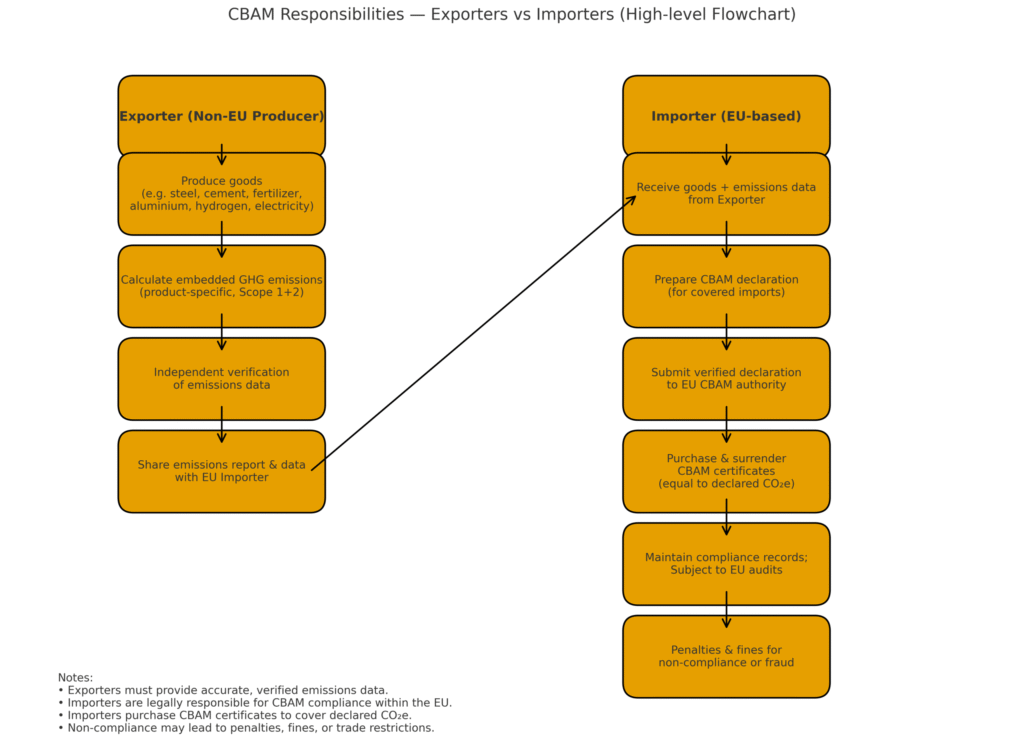
In the full implementation phase, importers must apply for authorised declarant status. They will need to calculate and declare embedded emissions, verified by an accredited verifier. Importers must then purchase the required number of CBAM certificates to cover emissions.
An annual CBAM declaration must be submitted by 31 May each year for the previous year’s imports. The EU will confirm whether the official start is in 2026 or 2027.

 Impact on Exports to the EU

For companies outside the EU, CBAM introduces new compliance and cost obligations.
 Reporting Requirements

Exporters must provide emissions data to EU importers to support CBAM compliance.

Cost Competitiveness

Products with a high carbon footprint will face higher costs under CBAM, reducing their competitiveness compared to cleaner alternatives.

Pressure to Decarbonize

Exporters are encouraged to adopt cleaner production methods and improve efficiency in order to maintain access to the EU market.

Compliance Risks

Failure to comply with CBAM rules or provide accurate data may lead to financial penalties, higher costs, or restricted market access.

Impact on Imports into the EU

For EU-based businesses, CBAM changes cost structures and supply chain dynamics.

 Rising Input Costs

Imports of carbon-intensive goods will become more expensive, as importers must cover emissions costs with CBAM certificates.

 Supplier Choice and Localisation

To limit costs, EU companies may look for suppliers with greener production or shift to local sourcing within the EU.

Administrative Burden

Importers face new reporting and compliance obligations, including collecting emissions data, filing reports, and managing certificates.


 Why CBAM Matters for Businesses

CBAM is more than a regulatory requirement – it is a strategic policy shift that will reshape global trade.

Companies should prepare now by:

 Identifying which products in their portfolio are exposed to CBAM.
Engaging suppliers to collect emissions data.
 Building internal compliance and reporting systems.
 Investing in **low-carbon technologies** to remain competitive in the EU market.

Early preparation will help businesses minimise risks, reduce costs, and secure long-term competitiveness in a carbon-conscious global economy.

The Carbon Border Adjustment Mechanism (CBAM) is a new policy by the European Union to support its climate goals under the Fit for 55 package, which aims to cut greenhouse gas emissions by 55% by 2030. The idea behind CBAM is simple: products imported into the EU should face the same carbon costs as goods produced within the EU. This prevents “carbon leakage,” where companies might otherwise move production to countries with weaker climate rules, and it ensures fair competition for EU industries already paying for their emissions through the EU Emissions Trading System (EU ETS).

CBAM currently applies to the most carbon-intensive sectors such as iron and steel, aluminium, cement, fertilisers, electricity, hydrogen, and certain semi-finished goods. Importers of these products must report the amount of greenhouse gases released during production and, once CBAM is fully in place, buy CBAM certificates to cover those emissions. The price of these certificates will be directly linked to the EU ETS carbon price, while any carbon price already paid in the exporting country will be deducted. This way, the system is both fair and transparent.

The rollout of CBAM happens in two stages. In the transition phase (October 2023 to December 2025), companies must submit quarterly reports on the emissions linked to their imports but do not yet need to buy certificates. This period is mainly for data collection and adjustment. From January 2026, CBAM enters full operation. At that point, importers must be authorized, have their emissions data verified by accredited bodies, purchase the necessary number of certificates, and file an annual declaration by 31 May each year.

For businesses outside the EU, CBAM means that exporting carbon-intensive goods to Europe will come with new costs unless they adopt cleaner production methods. For EU importers, it means higher costs for carbon-heavy goods, greater focus on greener suppliers, and new reporting responsibilities. While this adds an administrative burden, it also pushes global supply chains toward sustainability. In short, CBAM is not just a regulation—it is a powerful tool driving industries worldwide toward a low-carbon future.